


1. Overview of Russia’s Electric Mobility Market
Russia is the largest country in the world by land area, with a population of approximately 146 million. Its urban transportation landscape is developing rapidly. In recent years, electric mobility solutions—including electric bicycles, electric scooters, and light electric motorcycles—have begun to gain momentum in major Russian cities.
Traditionally, Russian consumers have relied heavily on private cars and public transportation. However, increasing urban congestion, fluctuating fuel prices, and rising environmental awareness are encouraging consumers to consider alternative mobility solutions.
According to research by Grand View Research and Mordor Intelligence, the Russian electric bicycle market has experienced strong growth in recent years, indicating increasing consumer interest and expanding market potential.

2. Market Size and Growth Trends
The Russian electric bicycle market has grown significantly between 2021 and 2024:
| Year | Market Size | Market Development |
|---|---|---|
| 2021 | USD 120 million | Early market stage |
| 2022 | USD 180 million | Rapid development |
| 2023 | USD 270 million | Market expansion |
| 2024 | USD 380 million | Continued development |
Forecasts indicate the market may reach:
●USD 520 million by 2025
●USD 700 million by 2026
Despite economic uncertainties and supply chain disruptions since 2022,demand for cost-effective transportation solutions continues to support market growth.
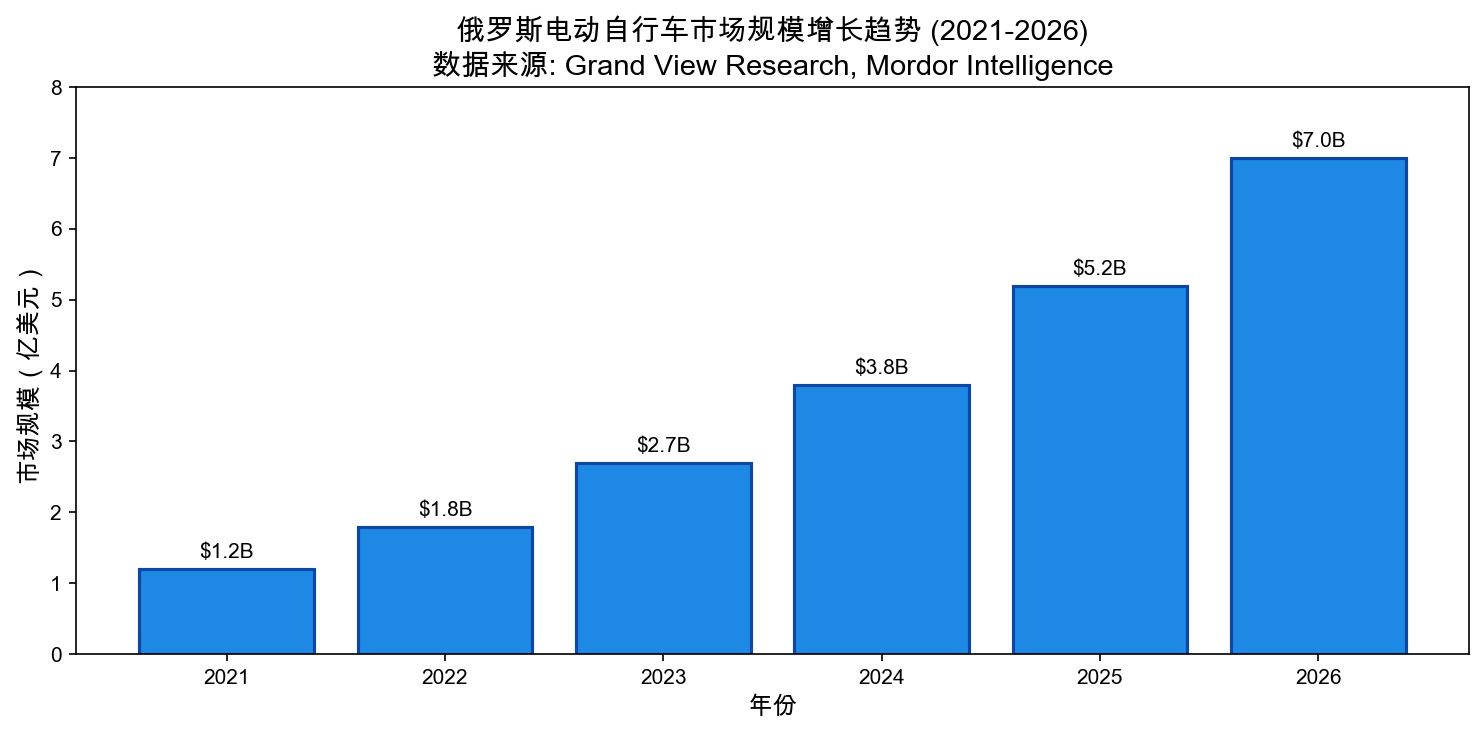
data sources:Grand View Research, Mordor Intelligence
Russia Electric Mobility Market Size Forecast 2024–2030
Forecast of Russia’s Electric Mobility Market Size, 2024–2030
3. Urban Mobility Demand and Carbon Reduction
Urban transport emissions are a key driver of the transition toward electric mobility.
According to the International Energy Agency (IEA), the global transport sector accounts for approximately24% of energy-related carbon emissions, with road vehicles being the primary contributors.
In Russia’s urban transportation system, emissions are distributed as follows:

Share of Urban Transportation Carbon Emissions in Russia
Figure 2: Carbon Emissions Share in Russia Urban Transport
| Transport Type | Emission Share | Reduction Path |
|---|---|---|
| Private cars | 42% | Promote shared mobility |
| Heavy vehicles | 28% | New energy replacement |
| Public transport | 15% | Electric buses |
| Two-wheelers | 10% | Increase e-bike penetration |
| Others | 5% | Integrated governance |
Data Source:IEA Transport Statistics
The relatively low share of two-wheel mobility indicates significant potential for electric bicyclesand electric scootersto replace short-distance car travel.
Data Source:McKinsey Urban Mobility Report
Adoption rates in major cities are increasing:
As the capital and largest city, Moscow has the highest penetration rate of electric mobility, reaching 18%. Although this level still lags behind that of developed European cities, it has already taken the lead in Russia.

| City | Penetration Rate | Growth Potential |
|---|---|---|
| Moscow | 18% | Steady growth |
| Saint Petersburg | 15% | High potential |
| Yekaterinburg | 9% | Large potential |
| Novosibirsk | 7% | Needs development |
| Kazan | 6% | Breakthrough potential |
| Rostov-on-Don | 5% | Positive long-term outlook |
Data Source:McKinsey Urban Mobility Report
4. Consumer Behavior and Purchasing Preferences
Consumer demand for electric mobility products varies by age group and urban lifestyle.
Research from Statista Consumer Insights shows that the Russia electric mobility market has clear age segmentation, with young urban professionals representing the largest consumer group.

Consumers aged 18–24 account for 25%, indicating a strong willingness among younger users to adopt new products and technologies. This group demonstrates open consumption attitudes and a readiness to try new brands, but their relatively limited budgets make them more price-sensitive.
The 25–34 age group represents the largest share at 42%, making it the core consumer segment for electric bicycles. As professionals in their prime working years, they face intensive daily commuting needs and place high value on efficiency and smart features.
Consumers aged 35–44 account for 35%. Typically serving as key family decision-makers, this group must balance work and family responsibilities, leading them to prioritize practicality and after-sales service.
Demand from consumers aged 45 and above is relatively lower, totaling approximately 26%. Within this segment, those aged 45–54 account for 18%, while consumers aged 55+ represent only 8%.
| Age Group | Demand Share | Typical Use Cases |
|---|---|---|
| 18–24 | 25% | Social, entertainment |
| 25–34 | 42% | Commuting, dating |
| 35–44 | 35% | Commuting, school pickup |
| 45–54 | 18% | Daily transport, exercise |
| 55+ | 8% | Short-distance travel |
Data Source:Statista Consumer Insights
Key purchase decision factors include:
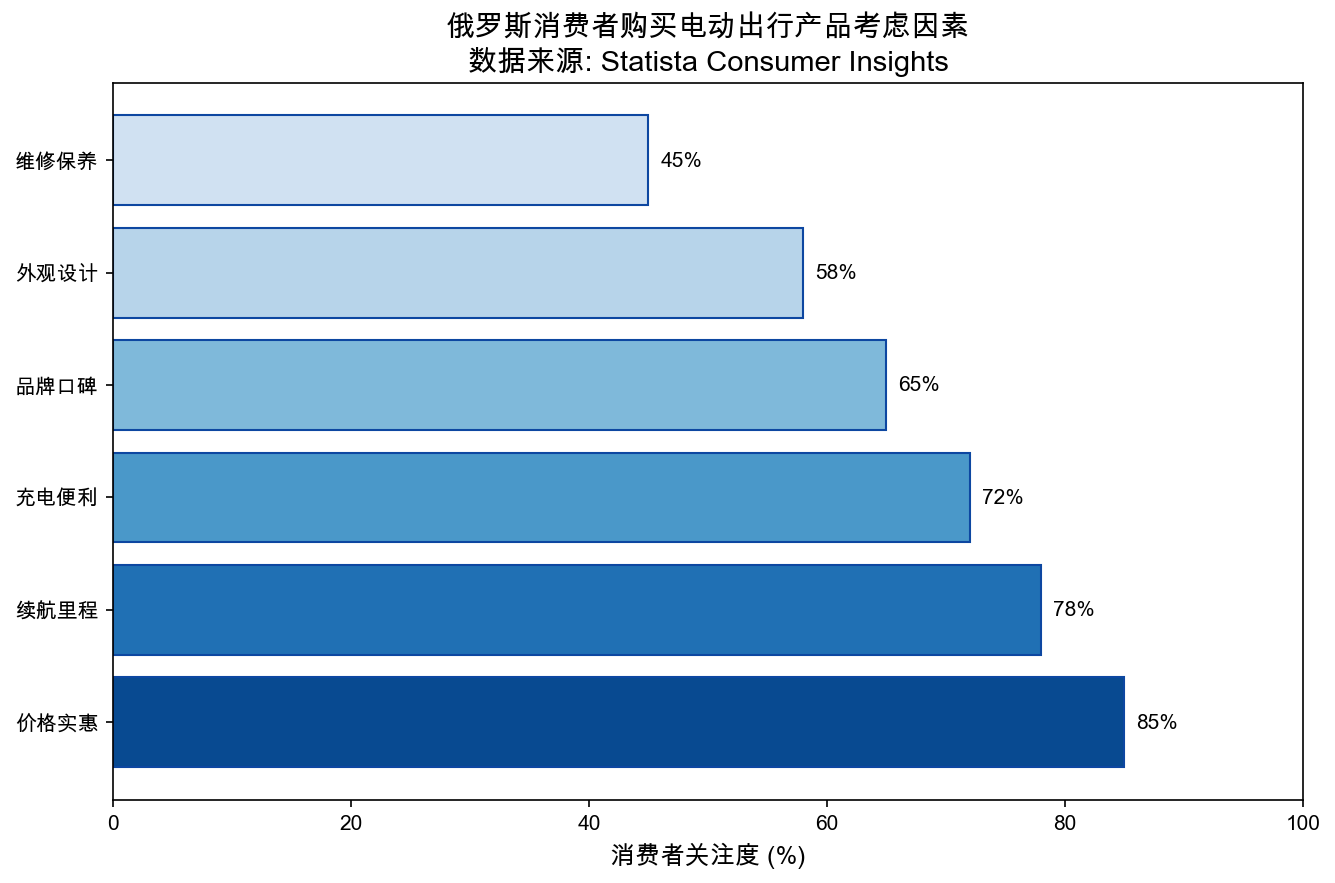
Data Source:Statista Consumer Insights
Affordability ranks first with 85% consumer attention, highlighting the strong emphasis Russian consumers place on **cost-performance**. Following economic fluctuations and the impact of sanctions, purchasing decisions have become more rational, making price the most critical factor.
| Rank | Factor | Attention Rate |
|---|---|---|
| 1 | Price affordability | 85% |
| 2 | Battery range | 78% |
| 3 | Charging convenience | 72% |
| 4 | Brand reputation | 65% |
| 5 | Product design | 58% |
| 6 | Maintenance | 45% |
5. Imported Brands and Market Competition
Data Source:UN Comtrade Database
Russia relies heavily on electric mobility imports.According to the UN Comtrade Database, China is the largest supplier, accounting for 65% of total imports, demonstrating strong manufacturing capability, competitive pricing, and supply chain flexibility.
| Country/Region | Import Share | Representative Brands |
|---|---|---|
| China | 65% | Yadea, Aima |
| Germany | 15% | Bosch |
| Netherlands | 8% | VanMoof |
| Japan | 5% | Yamaha |
| South Korea | 4% | Hyundai |
| Others | 3% | Various |
The product demand distribution reveals distinct market preferences:
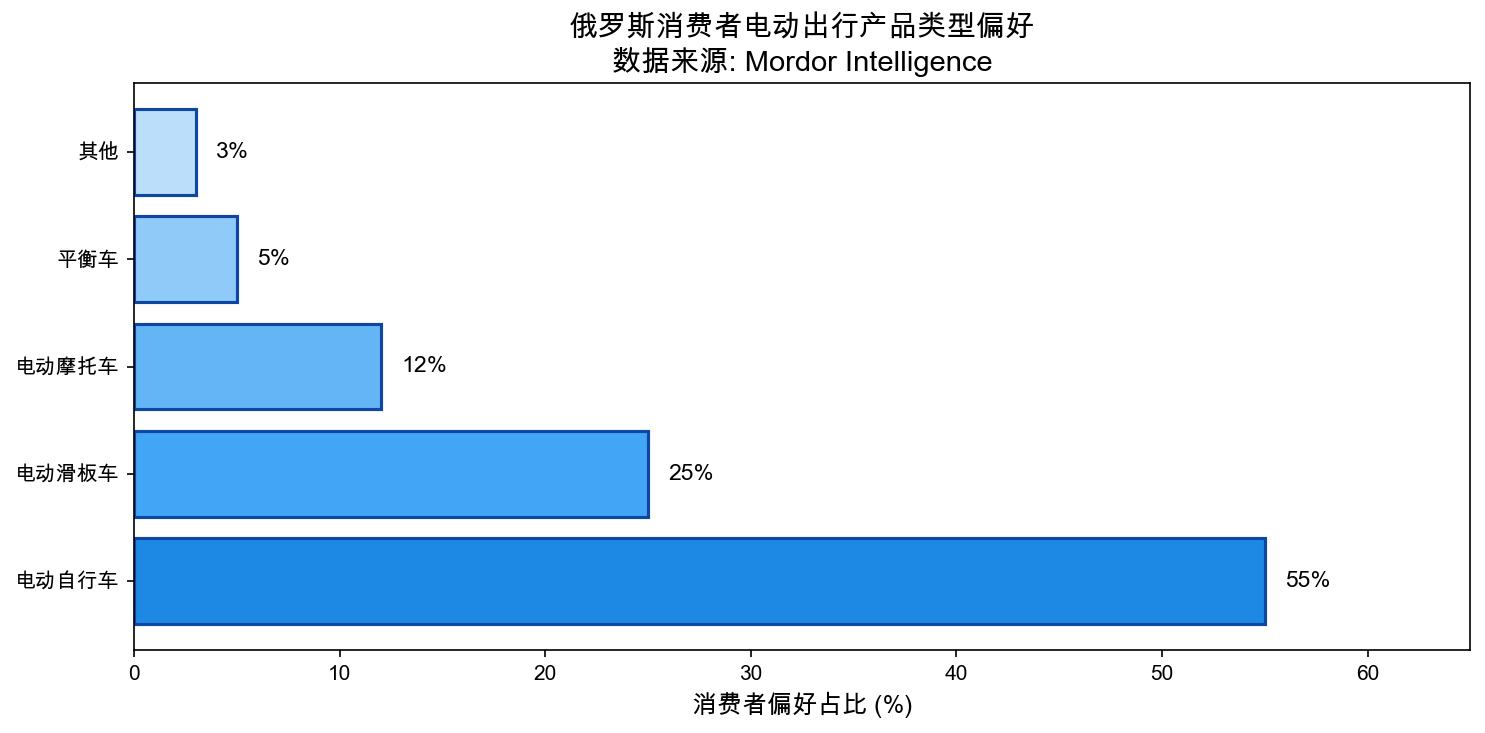
Data Source:Mordor Intelligence
Electric bicycles dominate with a 55% preference share, representing the option best aligned with Russia’s national conditions. Given the complex urban road infrastructure and the relatively large distances between cities, electric bicycles combine the agility of traditional bicycles with the convenience of electric assistance, effectively meeting most daily mobility needs.
| Product Type | Preference Share | Typical Users |
|---|---|---|
| Electric bicycles (e-bikes) | 55% | Family commuting |
| Electric scooters | 25% | Young singles |
| Electric motorcycles | 12% | Long-distance users |
| Balance scooters | 5% | Early adopters |
| Others | 3% | Niche markets |
6. Sales Channels and Distribution
Data Source:eMarketer Russia

Sales channels in Russia’s electric mobility market are also evolving. E-commerce has emerged as the dominant sales channel, accounting for 45%, surpassing the combined share of traditional channels. Key drivers behind this shift include the migration of consumer purchasing behavior to online platforms, improved logistics and delivery capabilities, greater product information transparency, and stronger price competitiveness.
| Channel Type | Sales Share | Key Advantage |
|---|---|---|
| E-commerce platforms | 45% | Price transparency |
| Brand stores | 25% | Experience & service |
| Bicycle shops | 18% | Professional advice |
| Electronics retailers | 8% | Stable traffic |
| Others | 4% | Niche markets |
7. Market Outlook
The Russia electric mobility market is entering a growth phase driven by urban transport challenges, demand for affordable mobility solutions, and rising sustainability awareness.
As cities continue investing in micro mobility infrastructure, electric bicycles and electric scooters will play an increasingly important role in urban transportation systems.
For global brands, the Russian electric mobility market represents a promising opportunity within the global micro mobility industry.
FAQ
Urban congestion, fuel price volatility,and growing environmental awareness are driving demand for alternative transportation solutions.Electric bicycles and electric scooters offer cost-effective and efficient mobility options for urban commuters.
The market size is approximately USD 380 million in 2024 and is expected to exceed USD 700 million by 2026. This growth reflects increasing consumer adoption and the expansion of distribution channels.
Electric bicycles are currently the largest segment, accounting for about 55% of consumer preference, followed by electric scooters. These products are widely used for daily commuting and short-distance urban travel. Light electric motorcycles are also gaining popularity.
Electric mobility products priced between USD 500 and USD 1,000 represent one of the most competitive segments. Consumers in this range typically seek strong performance at a reasonable price.
Chinese manufacturers benefit from mature supply chains, large-scale production capacity, and competitive manufacturing costs, enabling them to supply a wide range of products globally. PXID provides scalable manufacturing capabilities and flexible product development solutions for international clients.
Major cities such as Moscow and St. Petersburg show the highest adoption rates due to high urban density and increasing traffic congestion.
Price, battery range, charging convenience, and brand reputation are among the most important factors. Product design and durability also play a role.
Online retail has become the largest sales channel, accounting for approximately 45% of total market sales. Consumers increasingly rely on online platforms to compare products and prices.
Market forecasts indicate steady growth over the next decade, driven by evolving urban mobility needs and the expansion of micromobility infrastructure.
Manufacturers typically require strong product development capabilities, a reliable supply chain, and flexible production capacity. PXID offers end-to-end services, including industrial design, mold development, and integrated production, to support global mobility brands entering emerging markets.
For more information about PXID ODM services and successful cases of electric bicycles, electric motorcycles, and electric scooter design, and production, please visit https://www.pxid.com/download/
or contact our professional team to obtain customized solutions.
 Facebook
 Twitter
 Youtube
 Instagram
 Linkedin
 Behance
 tiktok

